An article from the future
An article from the future
Downtown West:
where all the city’s a stage
There is a long-held almost-universal truth in development: that big usually means bad. You can picture it now: the overblown claims followed some years later by the unveiling of shiny but shallow results. Grand projects that replace the rich textures of urban life with vast bland monocultural pieces of city. In the last two decades, the Bay Area has seen its own special version — generic-brand hipster developments aimed at tech campus workers seeking a bed and the best java. Many would argue this is market forces at work. But you could also argue — is that what we asked for? Is this what people really want? Is development’s blandification inevitable? You could ask: and Google did.
“We feel a great responsibility to get Downtown West right. San Jose is our home” says Alexa Arenas, Google’s director of real estate development, “We knew it couldn’t feel like an experiment: but we also didn’t want to repeat the Bay’s missed opportunities.” Alongside Lendlease, the result was a journey: a series of small acts that belie these two corporate behemoths. They moved into downtown, they put away the masterplan, and they listened. “The key moment came when we realised all of us — the city, the small businesses, Googlers — were missing the same thing: a stage to be ourselves”
Rethinking the downtown as a stage: it’s a poetic idea but why here? And what does that look like?
San Jose is the second largest city in California, and tenth largest in the country. Yet despite its wonderful history — from Spanish settlement to mercury mining, fruit canning to becoming the epicentre of western technological advancement — it failed to capture the collective imagination because there was no place to go to really understand it. Brilliantly diverse, its neighborhoods of Little Saigon, Calle Willow, Japantown were like the best ingredients, just without the melting pot. San Jose was a city of echo chambers: people trapped in their own bubbles of experience unable to bump into and understand each other without great personal efforts. A city bulging at the seams with people with big ideas, but who spent hours in cars or cloistered in tech campuses or shopping malls. “We saw the chance for a downtown where you experienced, tasted, listened, learned. That was really of and for the city. We wanted to create the stage: so that San Jose could be the performance”
We wanted to create the stage: so that San Jose could be the performance”
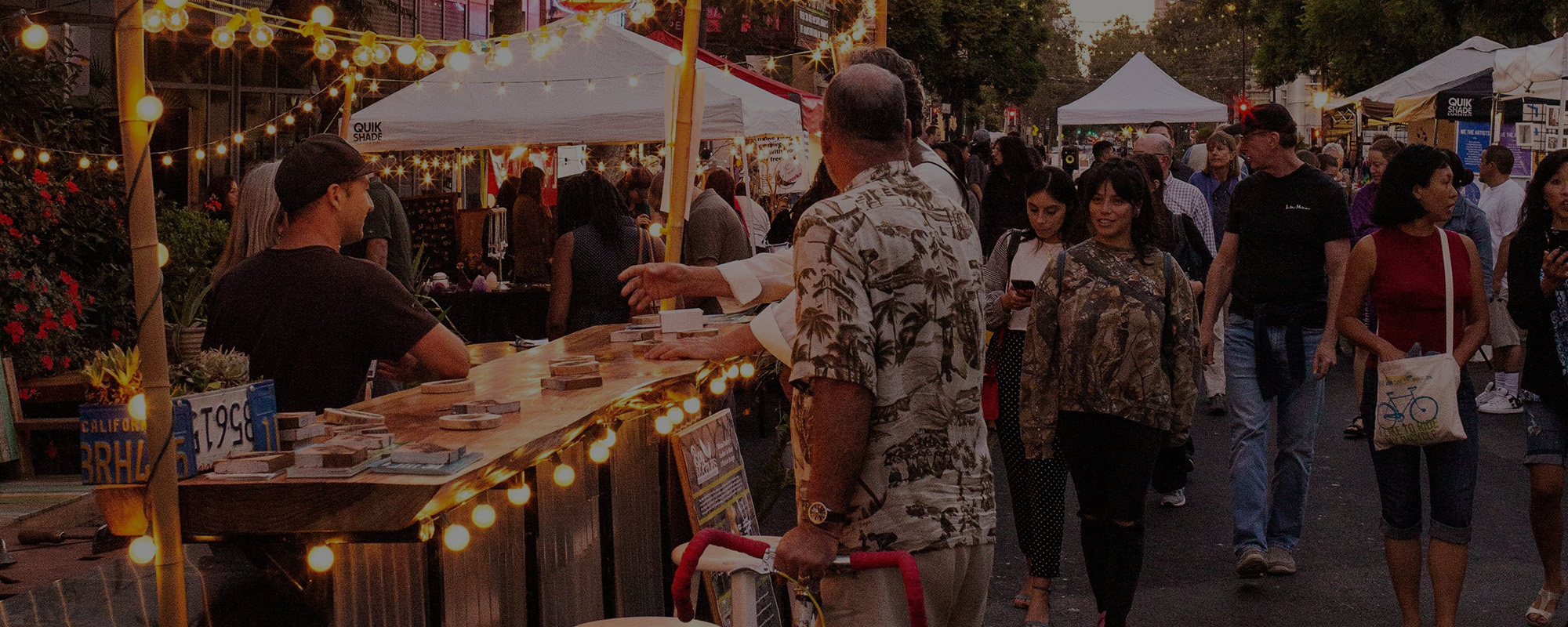
Walk Downtown West today, and for all the talk of incremental changes and experimental approaches, you’d imagine a mess of half-finished projects and half-hearted nods to community. But it isn’t. There is a sense of care and pride without the zealous control freakery of manicured suburban lawns. A gentle loose dare-we-say Californian-ness to its informal but substantial community gardens and inner-child-inspiring street fountains. There are odd in-between spaces too. A neveria selling aguas frescas and paletas is squeezed between a trendy coworking space and the freeway. The size of a small garage, it’s one of a collection of spaces open to local retailers and leased on a percentage of profits basis — a hugely successful initiative aimed at ensuring small business has a long term future as part of San Jose’s downtown experience. The initiative is also an online community where its dog groomers and sneaker sellers also trade tips and advice.
“It has meant a lot to us to be a part of the change. My family is excited again about the future of our business and our city. It’s brought back the smile to San Jose.”
— Angel Garcia Sanchez, neveria owner
One of the biggest beneficiaries of Downtown West has been a permanent home to San Jose Made — those champions of maker culture and the instigators behind one of the city’s most eye-catching new landmarks, Mademart. This striking building’s ground floor is half workshop half pop-up shop — a noisy friendly mash-up of making and selling to the smell of bubbling pho and cafe sua da, while its roof has been transformed into one of California’s best examples of urban farming with fields of peppers glistening in the sun to the rumble of Highway 87.
The introduction of greenery is perhaps one of the most fundamental changes to the ex-industrial post-core area around Diridon station. Take for example the section of the Guadalupe river walk at Downtown West, which has become an integral centre of civic life here. “The challenge was seeing if a river could become a useful meaningful public space” says chief gardener Beth Nguyen. The result is a 5-mile-long boardwalk following the river as it snakes through the city, and occasionally filling out to encompass small stages or play areas surrounded by palms. But look closer and you’ll spot that every incidental space is numbered — they are part of a network of programmable performance and educational spaces that San Joseans can log in and book for every scale of ambition and taste, from simple kids’ birthday parties to venues large enough to accommodate every member of SJSU’s Spartan Marching Band.
“A network of programmable performance and educational spaces that San Joseans can log in and book”
“The response at the start was pretty tentative” Lily Wong admits as head cultural programmer, “it was a new idea and there was some skepticism. We also quickly realized we need to promote the opportunity through print and word of mouth not just online. But the real turning point was its use during the San Jose Jazz Summer Fest takeover. People really got its potential. Since then, we’ve been running at 80% capacity every weekend.”
Wong’s admission isn’t the only misstep the team behind Downtown West are eager to share. Every conversation is a chapter in a tale of unfortunate events. Expensive learnings from constructing with cross-laminated timber. Backlashes around the radical reduction in car parking. Fiery moments in community engagement, although they’re quick to correct the term: “We didn’t engage, we didn’t consult: we cooked!” As a further demonstration of their unorthodox approach, Google and Lendlease have hosted bimonthly cook-outs where anyone from the community is welcome to come eat and discuss progress on-site. “People are more inclined to listen and consider things over food.”
“Mistakes are part of how we learn” CEO Sundar Pichai puts simply, “and it’s ultimately how we’ve been able to balance commercial value and community value.” A clear part of Google’s strategy was to actively avoid creating another ‘campus’ — not only because of an ideological shift in the business but because of the commerciality. “We wanted to work alongside other inspirational businesses and we also wanted to contribute to the kind of downtown San Jose and Googlers deserve.”
“We wanted to work alongside other inspirational businesses”
A key part of the overall strategy has been creating a range of highly-adaptable workspaces of varying sizes and finish, from HQ buildings to coworking, alongside retail spaces, small-scale cultural venues, and homes — mixing both market value and the affordable homes desperately needed in the city. But it doesn’t end there: Downtown West also includes its own daycare, school, health center, nursing home, and even a funeral home: “Yes, that certainly got some press! But that was about consciously breaking away from our everyday twenty-to-forty-something perspective. I mean, how are we all as businesses supposed to design responsibly for everyone from babies to the elderly without any connection to all stages of the human experience?”
It’s an interesting question for the future of all development, and all places. But today, in San Jose, it’s just one of the many questions Downtown West implores visitors to consider. Because this is a place that’s less about the answers and more about the questions. Questions that get us talking, thinking, reconsidering, imagining. Important questions like — why isn’t this what we asked for? Why don’t we ask what people really want more often? Does this mean development’s blandification is something of the past?

